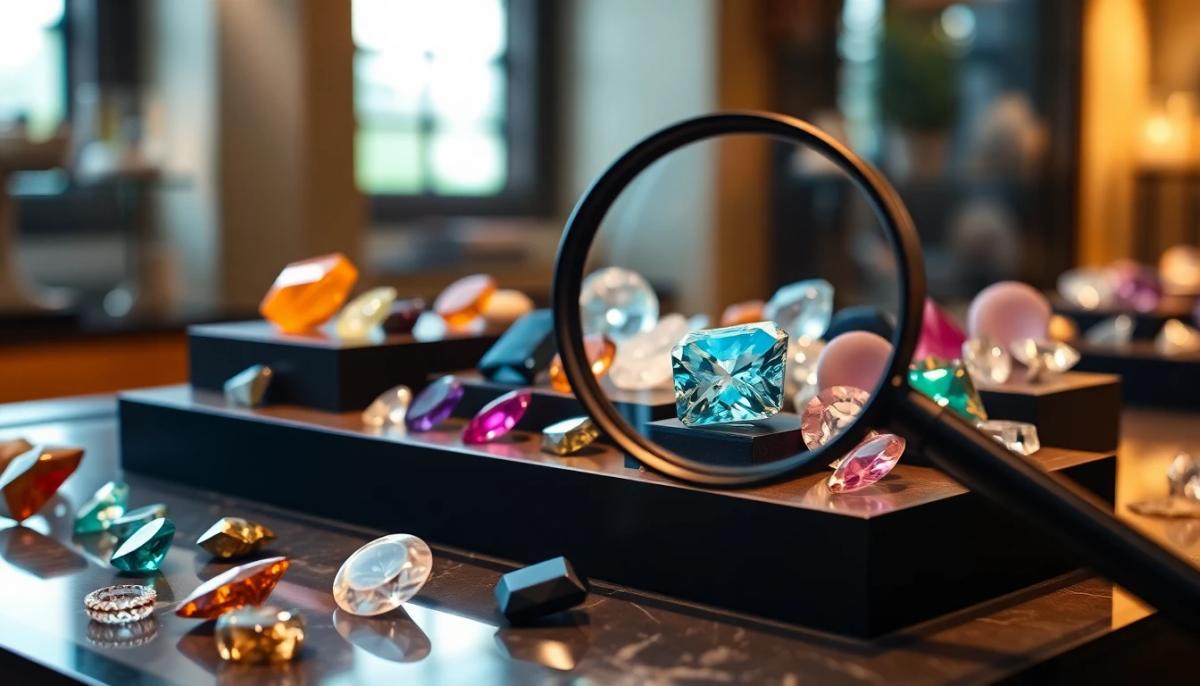
Ever wondered how experts identify those dazzling rare gems that make headlines and fetch astronomical prices? You're not alone. Whether you're a budding collector or simply fascinated by the world of precious stones, understanding how to spot and identify rare gems is a valuable skill. In this ultimate guide, we'll unveil 10 hidden secrets that will transform you from a curious onlooker to a savvy gem spotter. Get ready to dive into the sparkling world of rare gems
Rare gems have captivated human imagination for centuries. Their beauty, rarity, and value make them objects of desire and wonder. But how can you tell if that glittering stone you've stumbled upon is truly a rare gem or just a pretty rock? This guide will equip you with the knowledge and techniques used by gemologists to identify some of the world's most coveted treasures.
From the fiery red of rubies to the deep blue of sapphires, each rare gem has its own unique characteristics. By learning these traits, you'll be able to appreciate the intricate world of gemstones on a whole new level. So, let's embark on this gem-filled journey and uncover the secrets that lie within these natural wonders.
The Color Conundrum: Unlocking the Rainbow 🌈💎

Color is often the first thing that catches our eye when it comes to gems. But did you know that color alone isn't enough to identify a rare gem? Many stones can share similar hues. For instance, a deep red stone could be a ruby, a garnet, or even a spinel.
To truly identify a gem by color, you need to consider:
-
Hue: The basic color of the stone
-
Tone: How light or dark the color appears
-
Saturation: The intensity or purity of the color
Pro tip: Use natural daylight to assess a gem's true color. Artificial lighting can distort your perception.
Hardness Matters: The Mohs Scale Demystified 💎➡️💪
Understanding the hardness of gemstones is crucial for both identification and practical use in jewelry. The Mohs scale, ranging from 1 (softest) to 10 (hardest), provides a relative measure of a mineral's resistance to scratching. Here's an expanded look at where various popular gemstones fall on this scale:
One of the key factors in identifying rare gems is their hardness. Gemologists use the Mohs scale, which ranges from 1 (softest) to 10 (hardest). Diamonds, the hardest natural substance, sit at 10, while talc is at 1.
Here's a quick breakdown of some popular gems and their Mohs hardness:
- Diamond (10)
- Ruby and Sapphire (9) - These are varieties of corundum
- Topaz (8)
- Quartz (7) - This includes varieties like amethyst, citrine, and rose quartz
- Feldspar (6) - This includes moonstone and labradorite
- Apatite (5)
- Fluorite (4)
- Calcite (3)
- Gypsum (2)
- Talc (1)
Understanding hardness can help you rule out certain possibilities when identifying a gem. For example, if a stone scratches quartz, it's likely to be a sapphire, ruby, or diamond.
Crystal Clear: The Role of Transparency and Clarity 💎✨
Transparency and clarity play crucial roles in gem identification and valuation. Gems can range from completely transparent to opaque. Within this spectrum, you'll find:
-
Transparent: Light passes through easily (e.g., most diamonds)
-
Translucent: Some light passes through (e.g., some jade)
-
Opaque: No light passes through (e.g., turquoise)
Clarity refers to the presence of inclusions or blemishes within the gem. While some inclusions can lower a gem's value, others can be identifying characteristics. For instance, rutile needle inclusions in sapphires can create a star effect known as asterism.
Shape Shifters: Crystal Structures and Forms 🧊💎🔸
Every gem has a specific crystal structure that can aid in identification. Some common crystal systems include:
-
Cubic: Diamonds, garnets
-
Hexagonal: Emeralds, aquamarines
-
Trigonal: Rubies, sapphires
Observing a gem's natural crystal form can provide valuable clues. For example, emeralds typically form in hexagonal prisms, while garnets often form dodecahedrons.
Density Discoveries: The Power of Specific Gravity 🏋️♂️💎
Specific gravity is the ratio of a gem's weight to the weight of an equal volume of water. This property can be a powerful tool in gem identification, especially when dealing with lookalikes.
For instance:
-
Diamond: 3.52
-
Ruby: 4.00
-
Emerald: 2.76
By using specialized equipment, gemologists can measure specific gravity to differentiate between similar-looking stones.
Light Show: Understanding Optical Properties 🌈💎
How a gem interacts with light can reveal its identity. Key optical properties include:
-
Refraction: How light bends when entering the gem
-
Dispersion: The splitting of white light into spectral colors (think of a diamond's "fire")
-
Pleochroism: The appearance of different colors when viewed from different angles
For example, sapphires exhibit strong pleochroism, showing different shades of blue when rotated, while diamonds do not.
The Heat Is On: Thermal and Electrical Properties 🔥⚡
Some gems have unique responses to heat and electricity that can aid in identification:
-
Thermal conductivity: Diamonds conduct heat rapidly, which is why they feel cold to the touch
-
Electrical conductivity: Some gems, like hematite, conduct electricity
Specialized tools can measure these properties, helping gemologists distinguish between natural and synthetic stones.
Chemical Composition: The Elemental Secrets 🧪🧩
Every gem has a specific chemical makeup. While you can't see this with the naked eye, understanding the basics can help you grasp why certain gems behave the way they do:
-
Rubies and sapphires are both corundum (aluminum oxide), with different trace elements causing their distinct colors
-
Emeralds are a variety of beryl, colored by chromium or vanadium
This knowledge can help you understand why some gems are rarer than others and why certain treatments work on some stones but not others.
Fluorescence: The Hidden Glow 💡🌟
Some gems fluoresce under ultraviolet light, emitting a visible glow. This property can be a telltale sign in identification:
-
Many diamonds fluoresce blue under UV light
-
Ruby often shows a deep red fluorescence
-
Kunzite typically displays a bright orange glow
While not all gems fluoresce, this property can be a valuable tool in the identification process.
The Loupe Truth: Magnification Matters 🔍💎
A jeweler's loupe is an essential tool for any aspiring gem identifier. This small magnifying glass allows you to see details invisible to the naked eye, such as:
-
Inclusions that are characteristic of certain gems
-
Surface features that can indicate natural vs. synthetic origin
-
Cut quality and symmetry
With practice, using a loupe can reveal a whole new world within each gem.
Conclusion:
Identifying rare gems is a skill that combines science, experience, and a keen eye for detail. By understanding these 10 hidden secrets - from color assessment to chemical composition - you're now equipped with the fundamental knowledge used by gemologists worldwide.
Remember, while these techniques can guide you, true expertise comes with years of study and hands-on experience. If you're dealing with potentially valuable gems, always consult a certified gemologist for professional identification and appraisal. As you continue your journey into the fascinating world of rare gems, keep exploring, learning, and marveling at the wonders nature has created. Who knows? With your newfound knowledge, you might just discover a hidden treasure in the most unexpected place. Happy gem hunting!
You want to know more ? Get a glimpse at our recommended books category!
4.88 out of 5 stars
Gemstone Recognition Guide by DK Smithsonian
Discover the captivating world of gemstones and enhance your collection with expert insights and detailed information
Product information
Product Review Score
Product links
$12.90
$7.74
4.18 out of 5 stars
Rocks, Minerals & Gems Jewelry Collection
Discover the enchanting beauty of nature's treasures crafted into stunning jewelry pieces
Product information
Product Review Score
Product links
$4.50
4.34 out of 5 stars
Rocks and Minerals: A Collector's Guide
Explore the fascinating world of gemstones and enhance your collection with expert insights and tips
Product information
Product Review Score
Product links
